

Most players think agility is about speed, but true on-field movement depends on how quickly you can stop, start, and redirect your body without losing balance. The key to dominating as a Central Midfielder lies in refining specific movement patterns under pressure. By focusing on reactive movements rather than just linear sprints, you build the neural pathways needed to react to an opponent’s body shape in real time. This approach transforms your game by making your footwork automatic, allowing you to keep your head up and scan for passing options even during high-intensity duels.
Setting Up a Safe and Effective Training Zone
Before you touch a single cone, you need to secure a training area that allows for safe deceleration and rapid acceleration. A flat, non-slip surface is non-negotiable because uneven ground or wet turf increases the risk of ankle rolls and knee strain during sharp changes of direction. Mark out a square at least four meters wide with brightly colored cones or discs placed at each corner to define your working boundaries clearly. This space must be free of other players or equipment so you can focus entirely on your body mechanics without worrying about collisions.
Choose lightweight, flexible cones that will not hurt you if you trip over them during a fast-paced drill. Heavy metal bases are great for stability but become dangerous projectiles when you are moving at full speed and losing balance. Place the markers exactly where you need them, ensuring the distances between them match the specific drill you are about to perform. By adopting zonal marking, defenders can better organize their positioning and reduce confusion during play.
Mastering the T-Drill and L-Drill Foundations
The T-drill is a staple for good reason because it mimics the zigzag running patterns common in soccer matches. To excel as a forward, you must first master the Centre Position, focusing on precise movement and positioning. This sequence forces your legs to work independently, building the coordination needed to switch directions without crossing your feet awkwardly. Keep your knees slightly bent and your eyes fixed on the target cone rather than down at your shoes.
The L-drill adds a diagonal component that challenges your ability to cut at sharp angles while maintaining momentum. From a standing position, sprint forward, then sharply cut into a ninety-degree turn toward the second marker. This movement requires you to plant your outside foot firmly to generate force away from the direction of travel. Many players struggle here because they lean too far into the turn, causing their center of gravity to drift and slowing them down.
Both drills should be performed with controlled speed rather than maximum effort during the first few repetitions. Focus on keeping your hips level as you change direction, which prevents excessive side-to-side sway that wastes energy. As your form improves, gradually increase your pace while maintaining the same technical precision in every step.
Incorporating Reactive Cone Weaving Patterns
Static drills alone won’t suffice; incorporating reactive elements is crucial for realistic match preparation. Set up a row of five cones spaced two meters apart and practice weaving through them with your eyes closed or looking over your shoulder. This forces your brain to rely on proprioception, the internal sense of body position, rather than visual cues to guide your path. It builds the confidence needed to make tight turns in crowded areas without knowing exactly where the next defender is standing.
On Ian DS they explain this speed and agility drill—you can watch it right here.
For a more advanced challenge, have a partner call out “left” or “right” as you approach each cone. You must react instantly by stepping in the indicated direction, which trains your decision-making speed under pressure. This type of reactive agility training has been shown to improve performance metrics in youth players significantly because it bridges the gap between practice and play. The key is to keep your initial sprint commitment high so that your reaction does not compromise your forward momentum.
Building Balance with Single-Leg Stability Work
Agility is useless if you cannot maintain balance during contact, which is why single-leg stability work is a critical component of any serious routine. Stand on one leg and hold that position for thirty seconds while maintaining a neutral spine and relaxed shoulders. Progress to closing your eyes or standing on an unstable surface like a foam pad to increase the difficulty. This isolates the small stabilizing muscles in your ankles and hips that larger exercises often neglect.
Combine this with dynamic movements by performing single-leg hops over low hurdles or across a line of cones. Land softly with your knee tracking over your toes, avoiding any inward collapse that signals weak gluteal muscles. Each hop should be controlled, focusing on the quality of the landing rather than the height or distance covered. Strong, stable legs allow you to absorb impact from a tackle and recover your balance before the next play begins.
Integrating Speed and Change of Direction
agility drills soccer players must know often include specific change of direction tests that measure how efficiently you convert forward speed into lateral movement. Try the Illinois agility test, which involves sprinting down a lane, weaving through cones, and returning to the start as quickly as possible. This drill penalizes any loss of momentum, teaching you to stay low and compact throughout the entire sequence. Time yourself with each attempt to track your progress and identify exactly where you are losing speed.
Focus on the technique of “driving” your lead knee through the cone during turns rather than reaching for it with your foot. This mechanical cue ensures that your hips rotate properly, generating power from your larger muscle groups instead of straining your smaller stabilizers. If you find yourself stumbling or crossing your feet, slow down and repeat the movement until the pattern feels natural and efficient.
Avoiding Common Technical Errors
One of the most frequent mistakes is looking down at the ground during quick turns, which disrupts your spatial awareness and slows your reaction time. Train yourself to keep your gaze fixed on a target point ahead or scan the field continuously, even while performing complex footwork. This habit carries over directly to match situations where you need to see the ball arriving before it reaches you.
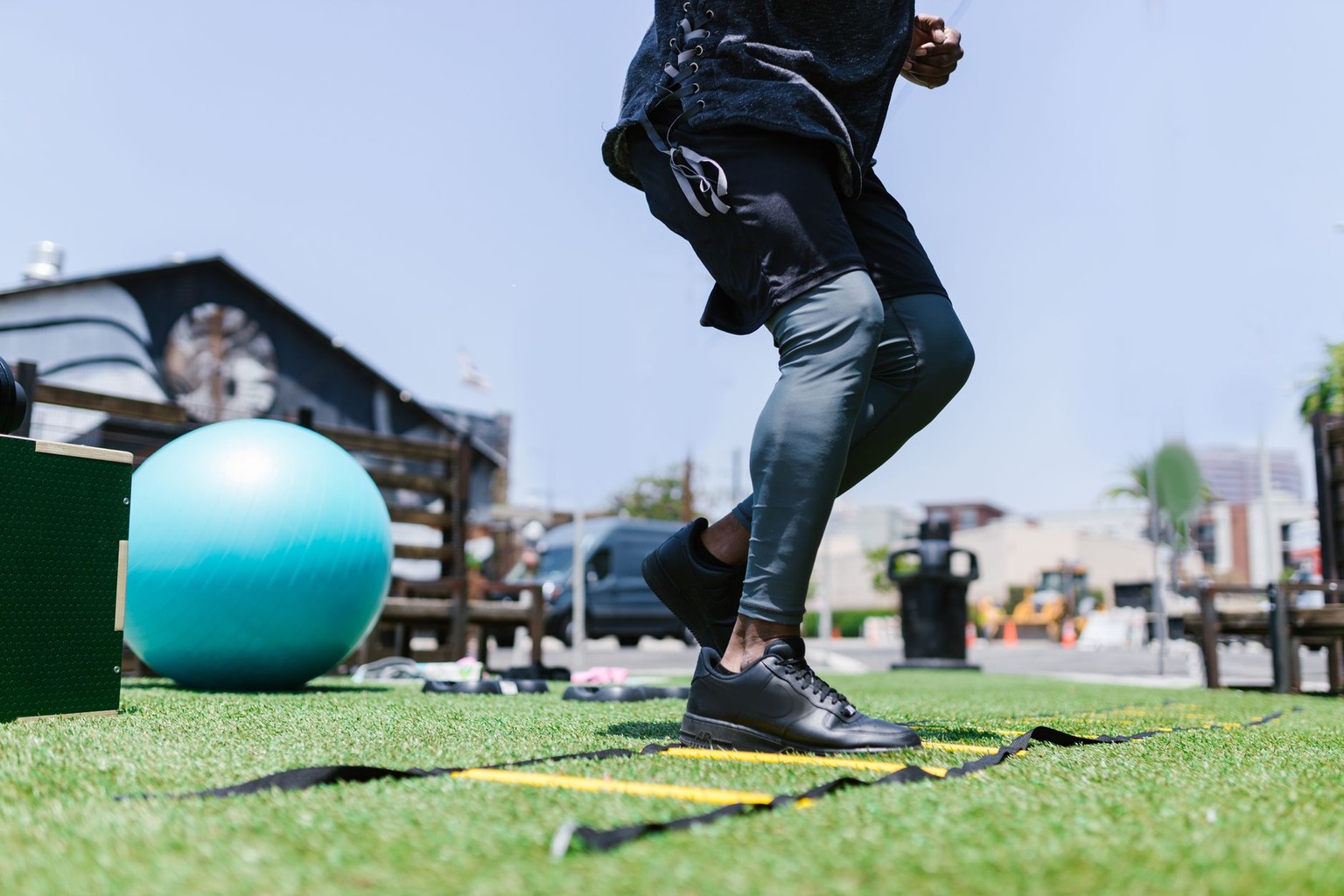
Another error is using too much arm swing during lateral shuffles, which throws off your center of gravity and makes you look unbalanced. Keep your arms relaxed at your sides or slightly bent for counterbalance, avoiding large sweeping motions that waste energy. Your arms should move only as much as necessary to maintain stability, acting as subtle guides rather than primary drivers of movement.
Finally, do not ignore the importance of cooling down after intense agility work. Static stretching for the hamstrings, quads, and calves helps reduce muscle tightness and prepares your body for the next session. Neglecting this recovery phase can lead to chronic soreness and increased injury risk over time, undermining all the hard work you put into training.
Structuring Your Weekly Agility Routine
Consistency matters more than intensity, so aim to include dedicated agility sessions two or three times per week rather than one exhaustive workout. Spread these sessions throughout your week, ideally on days following lighter technical training to ensure you are fresh enough to focus on quality. Each session should last between twenty and thirty minutes, long enough to fatigue the nervous system but short enough to maintain high performance levels.
Begin every session with a dynamic warm-up that includes leg swings, high knees, and light jogging to raise your core temperature. Follow this with your chosen drills, performing three to four sets of each with adequate rest periods between attempts. Track your times and repetition counts in a notebook or app so you can see measurable improvements over weeks. This data-driven approach keeps you motivated and ensures you are progressing rather than just going through the motions.

I’ve been kicking a ball around since I could walk, and the strategy behind the beautiful game never stops fascinating me. I love breaking down match tactics and sharing the stories of players who make football unforgettable.